How can prosumers sell at market prices
Solar-panel cooperatives found the loophole to get better yield for home-made power
 Teodora Cimpoi
from
Bucharest
about
Cluj
For anyone who's bolted solar panels to their roof, success used to be measured in kilowatt-hours generated. This year's energy crisis rewrote that equation entirely: what matters now is the price you can fetch for your electricity.
Batteries and digital platforms are ushering in a new chapter: prosumers can become active players in the energy market, with their flexibility actually paying off. Looking ahead, surplus power could even be sold automatically to other households or businesses, while the electricity you need gets bought at the most advantageous moments—all according to rules the owner sets in advance, without anyone having to obsessively track prices.
A household's solar output peaks around noon—exactly when thousands of other rooftop installations are also pumping electricity into the grid. In summer especially, this flood of supply can push wholesale prices toward zero, or even into negative territory.
For prosumers who've so far judged their return on investment purely by net metering and lower energy bills, the next frontier is smart management of production, consumption and storage. New digital tools powered by artificial intelligence and machine learning are changing the game, squeezing more value out of the energy prosumers generate. But the real key is collaboration.
Strength in numbers
A lone prosumer has negligible capacity and can't muscle their way into wholesale energy markets. Aggregation changes the equation entirely: hundreds or thousands of installations can be coordinated via software into what's known as a Virtual Power Plant, or VPP. Pooled together in a VPP, a scattered army of small-scale setups can become a serious player on the grid.
The concept is often compared to the much more well-known Uber or Airbnb. Just as Uber does not own any cars and Airbnb does not own any apartments, neither do P2P platforms produce energy but only connect demand with supply.
In Romania, Cluj-based tech company YellowGrid has rolled out exactly this kind of model, linking up prosumers' systems and managing their energy output in step with market swings. "We set out to build YellowGrid as a collective of prosumers working together, so they could import and export power at the hours when energy prices are far more favourable," explained Cătălin Stâncel, co-founder and CEO of the company, on the Power Talks podcast.
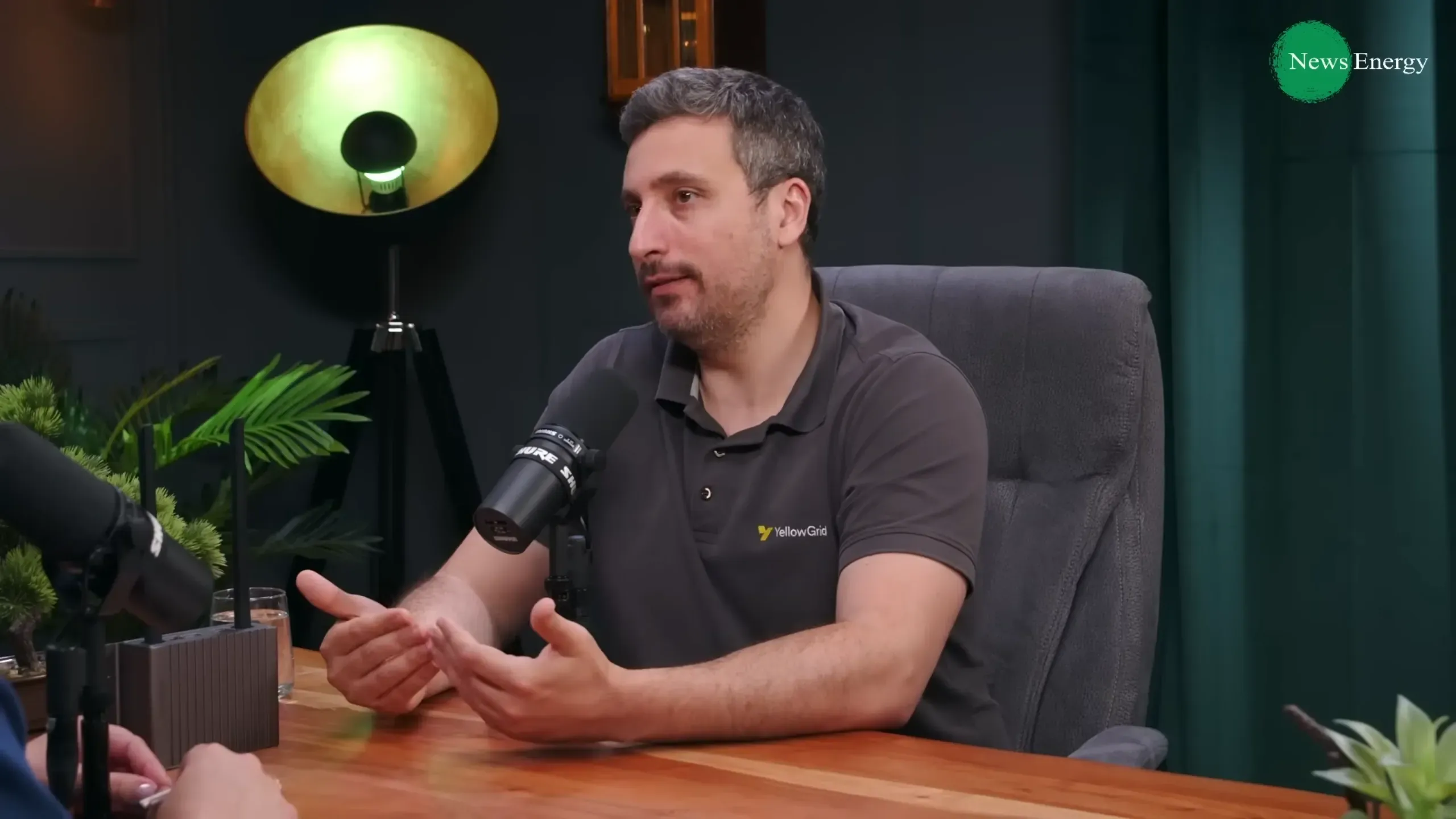
The platform orchestrates charging and discharging across its fleet of prosumer batteries, crunching production forecasts, consumption patterns and energy prices in 15-minute windows. Licensed as a supplier, the company handles its prosumers' market participation on their behalf, selling power when prices spike. Or working the opposite angle: in winter, for instance, it can buy cheap electricity, stash it in batteries, and resell it once prices climb. That means prosumers can turn a profit even in the depths of winter. Through the app, each owner sets the boundaries within which the system is allowed to operate. "We can trade energy on your behalf. You get full visibility—you can see everything, set your own limits, and cash in on energy market prices you'd normally have zero access to," says Stâncel.
In this emerging landscape, flexibility has become the name of the game: the ability to shift consumption or tweak battery use according to what the grid needs and what the market's paying. For households, plugging into these systems can translate into savings or extra income, depending on the services rendered and contract terms. But the payoff hinges on price spreads, transaction costs, and battery wear and losses.
Local energy markets are taking shape
Energy communities add yet another layer to this shake-up: individuals, businesses and local authorities can band together for joint projects spanning production, consumption and storage. Where the legal framework allows, energy generated this way can be shared among participants, helping meet the community's needs collectively.
Romania's legislative framework is now catching up, with the first officially registered energy communities starting to materialise. ANRE's national registry recently welcomed the Portului Community Association, filed under renewable energy communities, and the Micăsasa Energy Cooperative in Sibiu county, the country's first citizen energy community. These pioneering initiatives pave the way for projects where participants jointly produce and manage energy at the local level.
Meanwhile, digital platforms are opening the door to peer-to-peer trading, letting producers and consumers buy and sell energy directly, cutting out the middleman. A prosumer could, say, sell their surplus straight to a neighbouring household, a local school, or a nearby business. These exchanges can happen both within energy communities and via platforms linking participants across different regions.
The software matches sell offers with buy requests based on quantity, timing and price. When the terms line up, the deal goes through automatically, no haggling required for every single exchange. This kind of model is already up and running in Australia and, closer to home, in Austria, through platforms like Localvolts and eFriends.
"eFriends with benefits", energy-flavoured, this time
In Austria, for instance, the eFriends platform lets individuals, farms and companies sell their renewable energy surplus and pick exactly who they buy electricity from, at prices hashed out among participants themselves. Through the app, users can track production, consumption and energy exchanges in real time. If the community's available energy falls short of demand, the gap is automatically covered by eFriends Energy GmbH, sourced from renewables.
Joining means switching your electricity supplier to eFriends Energy GmbH, which handles cancelling your previous contract. Users get access to the app and, where needed, the metering equipment required. Electricity can be shared across different Austrian states, smoothing out the weather-driven supply swings between regions.
Beyond real-time tracking of your energy balance through the web app, members get another perk: roughly 35% lower grid costs for sharing electricity locally with nearby community members, the company says.
When deals get put on autopilot
Australia, one of the most developed prosumer markets in the world, is already pointing us to the next level for peer-to-peer transactions. For example, according to the company Localvolts, automated optimizations will be possible, in which batteries, electric vehicles, and even household appliances can automatically turn on and off depending on the electricity price at that moment. In an even more advanced scenario, AI agents could formulate offers, negotiate, and execute energy exchanges within the limits set by owners. The decisions – assisted by artificial intelligence – would take into account the production and consumption profiles of the participants and price forecasts, in order to identify the most advantageous moments for buying or selling.